

AI shop management for auto repair
The best AIshop managementsoftware.
Don’t let your competitors beat you with AI and automation.
One system that runs the shop and works the phone. Not one more tab for your writer to type into.
- Answers every call, night and weekend
- Texts estimates and chases approvals
- Orders parts and flags vendor delays
The board, this morning
Every job, and who moved it last
Emerald — ZOL did it unattendedAmber — a person took over
Fifth Street Auto
Bakersfield, CA · 6 bays
All 6In bay 3Waiting on customer 1Waiting on parts 1Ready 1
| RO | Vehicle | Job | Last move |
|---|---|---|---|
| RO-4471In bay | 2018 Ford F-150 XLT8XKR241 | Front brakes + rotors | Call answered 9:41pZOL |
| RO-4459In bay | 2016 Ram 1500 Big Horn5KJB728 | A/C not cooling | Booked from voicemailZOL |
| RO-4456In bay | 2014 Nissan Altima 2.5 S6WQX155 | Alternator replacement | Approval received 8:12aZOL |
| RO-4465Waiting on parts | 2015 Chevrolet Silverado 15004YHN092 | Transmission service | Part ordered 11:20aZOL |
| RO-4468Waiting on customer | 2020 Toyota RAV4 LE9CMD517 | Check engine diagnostic | Estimate sent 10:04aZOL |
| RO-4462Ready | 2021 Hyundai Elantra SEL8PDF470 | Oil service + tire rotation | Picked up, invoice paidPerson |
- RO-4471In bay2018 Ford F-150 XLTFront brakes + rotorsZOLCall answered 9:41p
- RO-4459In bay2016 Ram 1500 Big HornA/C not coolingZOLBooked from voicemail
- RO-4456In bay2014 Nissan Altima 2.5 SAlternator replacementZOLApproval received 8:12a
- RO-4465Waiting on parts2015 Chevrolet Silverado 1500Transmission serviceZOLPart ordered 11:20a
- RO-4468Waiting on customer2020 Toyota RAV4 LECheck engine diagnosticZOLEstimate sent 10:04a
- RO-4462Ready2021 Hyundai Elantra SELOil service + tire rotationPersonPicked up, invoice paid
Fig. 01·The board, on sample data — the app itself is in section 05
- Cars in bays
- 4
- of 6 bays
- Calls answered
- 3
- today, by ZOL
- Awaiting approval
- 2
- needs a customer reply
- Avg text reply
- 8s
- ZOL, unattended
01
02
03
04
Fig. 02·The morning in numbers — same board, sample data
01·How it works
From the missed call
to the follow-up
One job, start to finish. ZOL runs the emerald steps unattended and hands you the rest.
- 019:41 PM
The call
Four hours after close, ZOL picks up. Complaint, vehicle, callback — then it books the slot.
ZOL2m18s · complaint, VIN and callback captured
- 027:12 AM
The diagnosis
Your tech scans the car. Codes and findings attach to the record the call already opened.
PersonP0455 · purge valve stuck open, found on smoke test
- 038:30 AM
The quote
The estimate texts out with a photo and the reasoning. One nudge, then a person takes over.
ZOL$742.18 texted · approved by reply in 4 minutes
- 044:20 PM
The follow-up
Ready notice, invoice, payment at your counter — and the next visit already on the book.
ZOLReady notice texted · invoice sent · follow-up set
02·One record
Everything on
one ticket
RO-4471 exactly as it happened — after-hours call through invoice. Nothing retyped into a second system.
Emerald — ZOL did it unattendedAmber — a person took over
RO-4471Vehicle
2018 Ford F-150 XLT
- Plate
- 8XKR241
- VIN
- 1FTEW1EP4JKD82910
- Mileage
- 118,420
- Bay
- 2
Pedal pulse above 45 mph. Rotors measured below spec at 26.1 mm. Rears still have roughly 40% left.
Approved total$742.18
Timeline6 events · 4 unattended
Call answered
Mon 9:41pZOLAfter hours. 2m18s. Captured the complaint, VIN and callback preference.
Ticket written
Tue 7:52aPersonService writer Dana K. confirmed the vehicle and opened the job.
Estimate sent
Tue 8:30aZOL$742.18 texted to (661) 555-0142 with the rotor measurement attached.
Approval received
Tue 10:15aZOLCustomer replied YES by text. The RO released to the board on its own.
Job started
Tue 12:40pPersonTech Manny R. pulled the truck into bay 2.
Ready notice + invoice
Tue 4:20pZOLCustomer told the truck was done, invoice texted, next service scheduled.
Fig. 03·Sample repair order RO-4471 — sample data
03·Runs itself
The work your front
desk never gets to
Four jobs ZOL does end to end — and hands back the moment judgment is required.
It answers the phone
Nights and weekends. It takes the complaint, the VIN and a callback — or transcribes the voicemail and books from it.
Booked from voicemail — transcribed 6:48p, booked 8:00a
It texts back in seconds
Inbound texts get a real answer before you open. ZOL offers slots, confirms one, writes it to the board.
Inbound text 7:02a — answered in 8 seconds
It chases approvals
The estimate goes out with a photo and plain-English reasoning. One nudge if nobody replies, then a person takes it.
No reply after 20h — one nudge sent, then paused
It catches parts delays
Parts get ordered against the approved estimate. When a vendor moves an ETA, the bay conflict surfaces early.
Vendor moved ETA to Thursday — bay 4 conflict flagged
Your numbers
What the missed ones are worth
After hours, or nobody free to grab it.
Callers with real work to sell.
Parts and labor together.
Walking out the door each year
$104,832
12 × 52 × 40% × $420. Your arithmetic, not our claim.
See it on your own numbers04·Why shops switch
Your shop software
only writes it down
Every shop system records the work. Someone still has to answer the phone, chase the approval, call about the part. ZOL does both.
Built to replace
- Tekmetric
- Shopmonkey
- Shop-Ware
- Mitchell 1
- AutoLeap
History comes across during onboarding. Your data stays exportable.
Shop software alone
On ZOL
After-hours phone
Shop software aloneVoicemail, or a separate answering service
On ZOLAnswers, triages and books the slot
Inbound texts
Shop software aloneAnswered when someone gets a minute
On ZOLAnswered in seconds, appointment written to the board
Writing the ticket
Shop software aloneSomeone retypes the call into the system
On ZOLThe call is already the repair order
Estimate approvals
Shop software aloneYour writer calls back twice and gives up
On ZOLTexted, nudged once, then handed to a person
Parts delays
Shop software aloneYou find out when the car is on the lift
On ZOLVendor ETA change surfaces the bay conflict early
What you pay for
Shop software aloneShop software, plus an answering service, plus a texting add-on
On ZOLOne system, one bill
05·The product
This is ZOL,
as it runs today
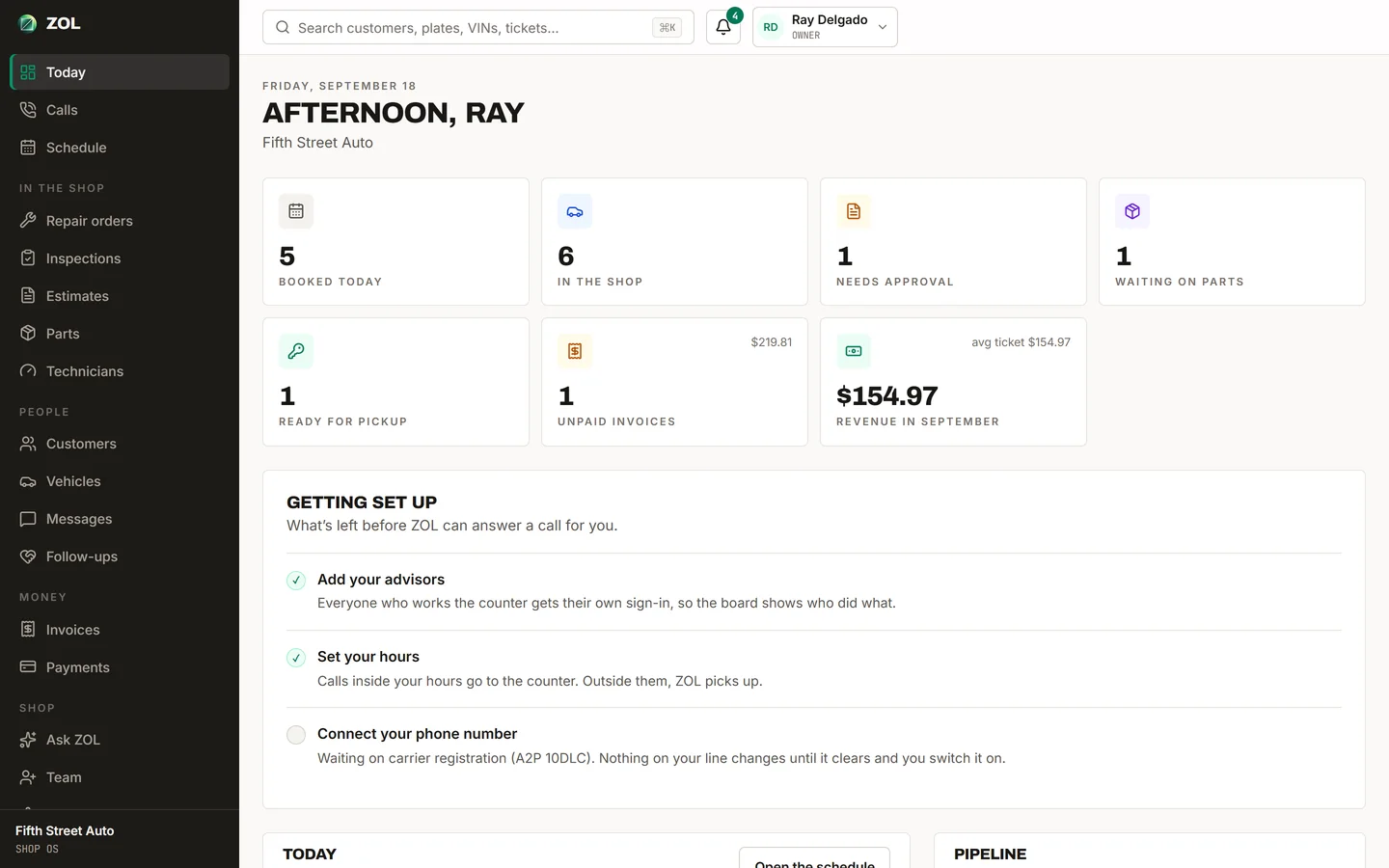
Screens from the app, not mockups. A shop sets itself up in two minutes, invites its team, and runs the day from here — and its customers approve estimates and pay from a text, with nothing to install.
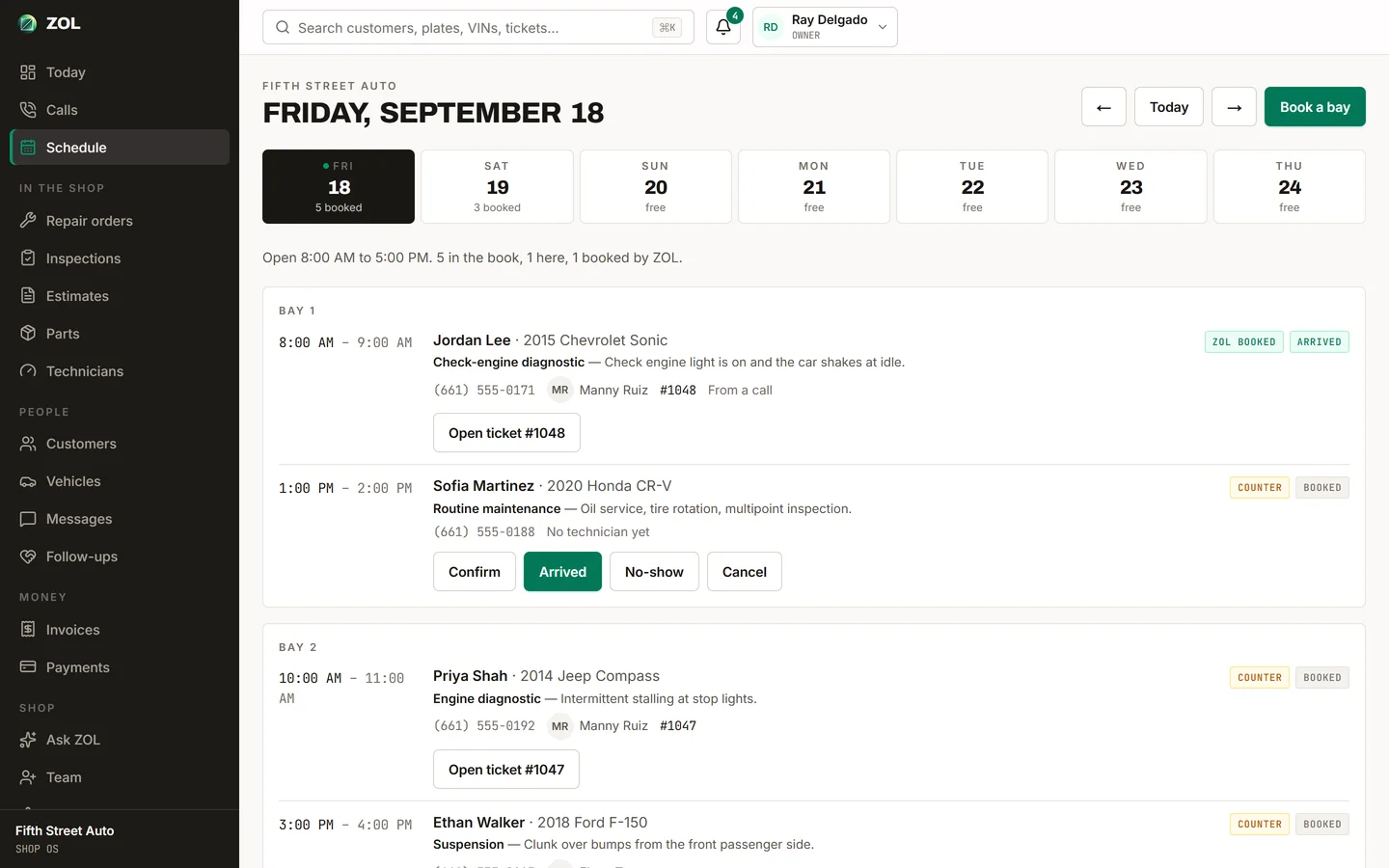
A day per bay, with technicians. Arrive, check in, and the ticket opens itself.
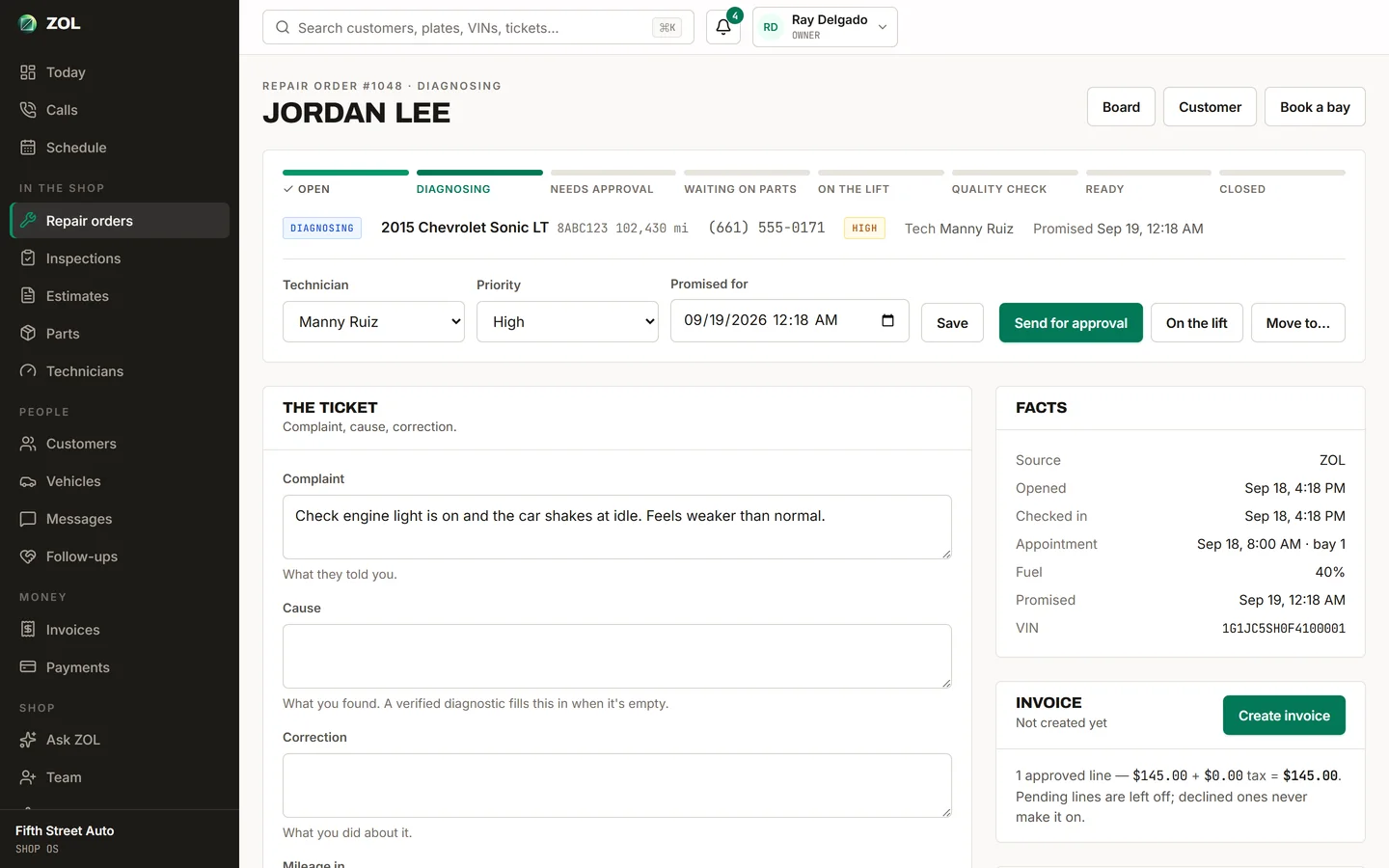
The workbench: diagnostics, digital inspection, lines and approvals, estimate, parts, invoice, history — one ticket.
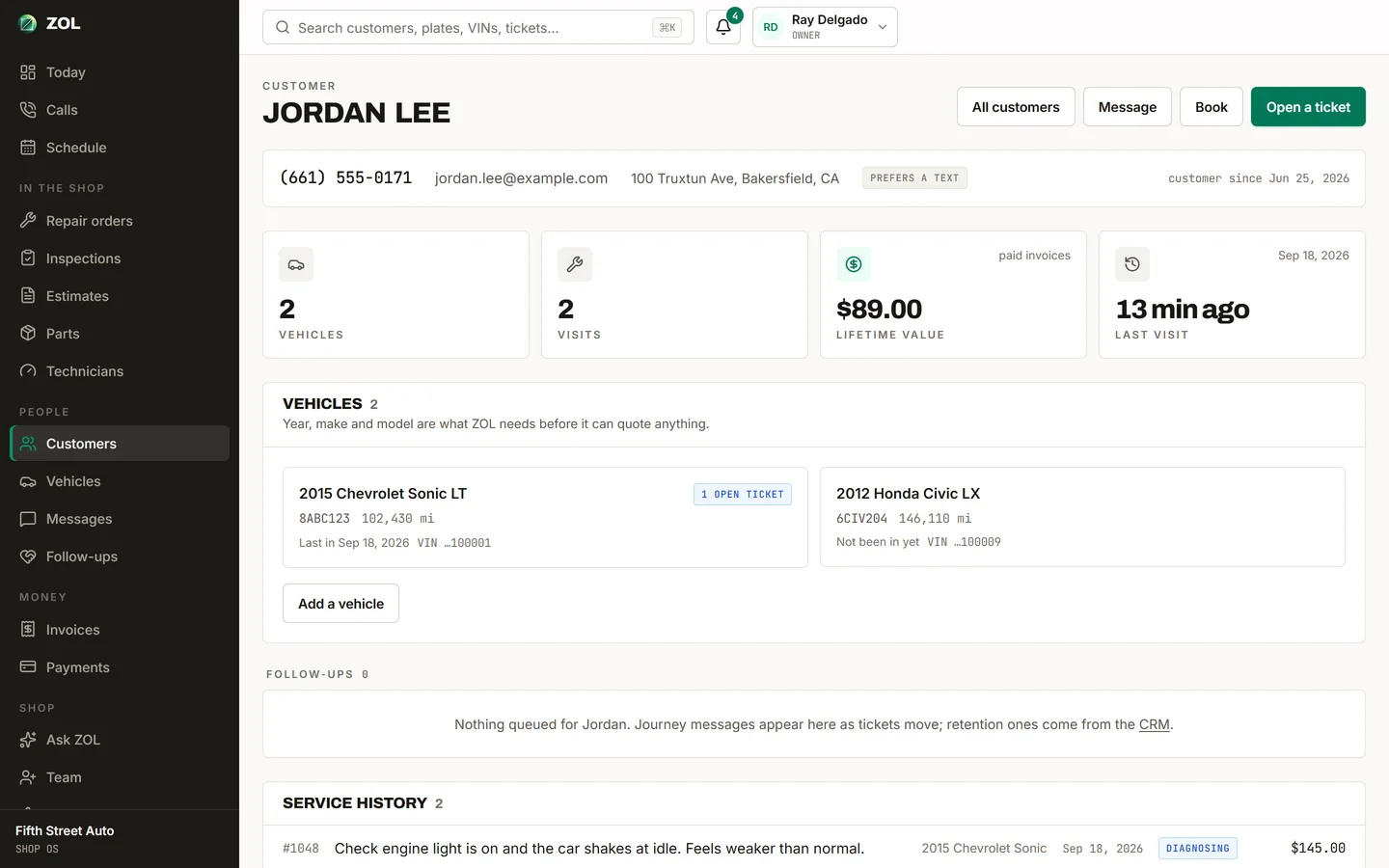
The connected record: vehicles, visits, messages, declined work, lifetime value — and a ticket or a text one click away.
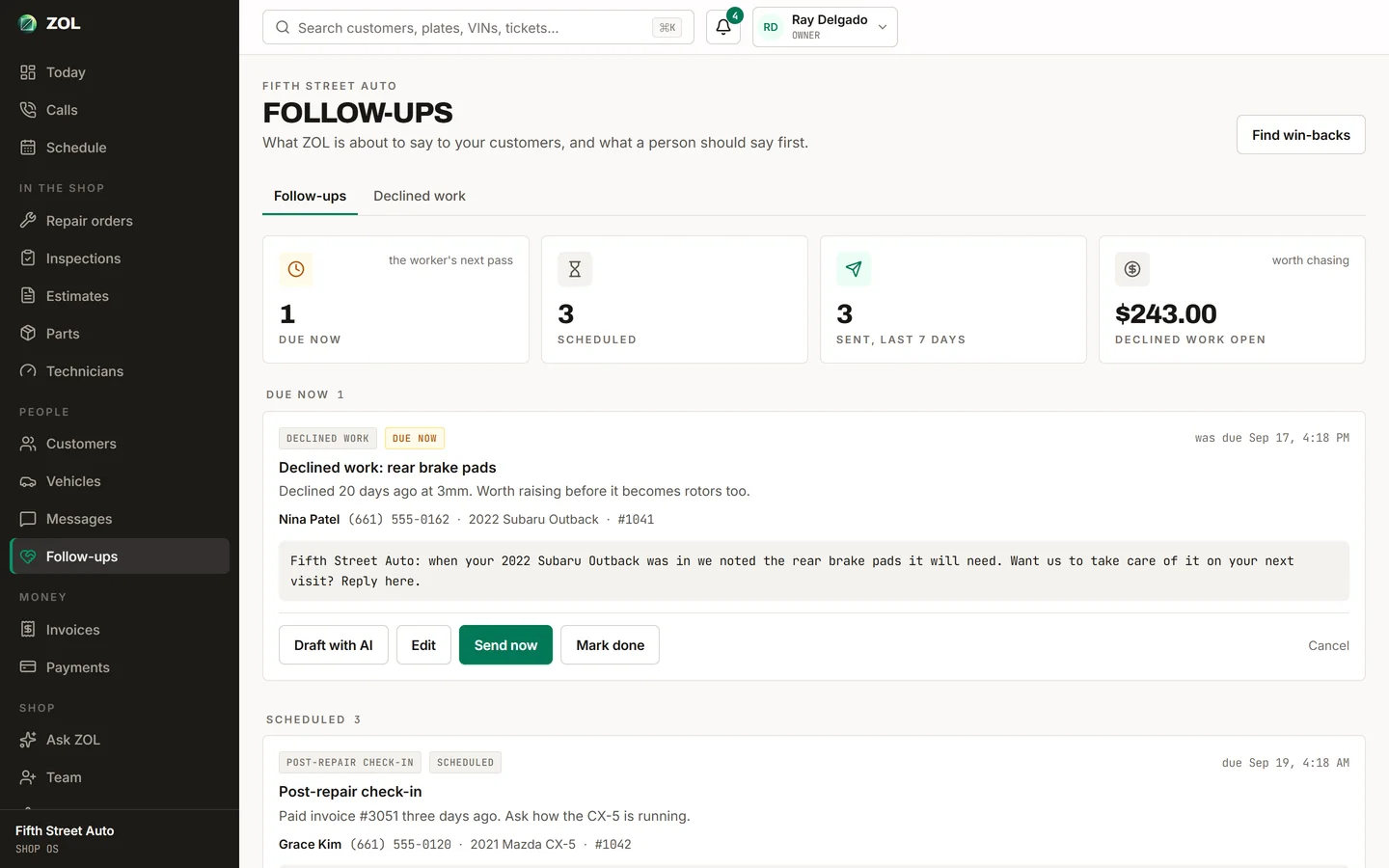
The CRM: declined work, inspection recommendations, post-repair check-ins — drafted by ZOL, sent by a person.
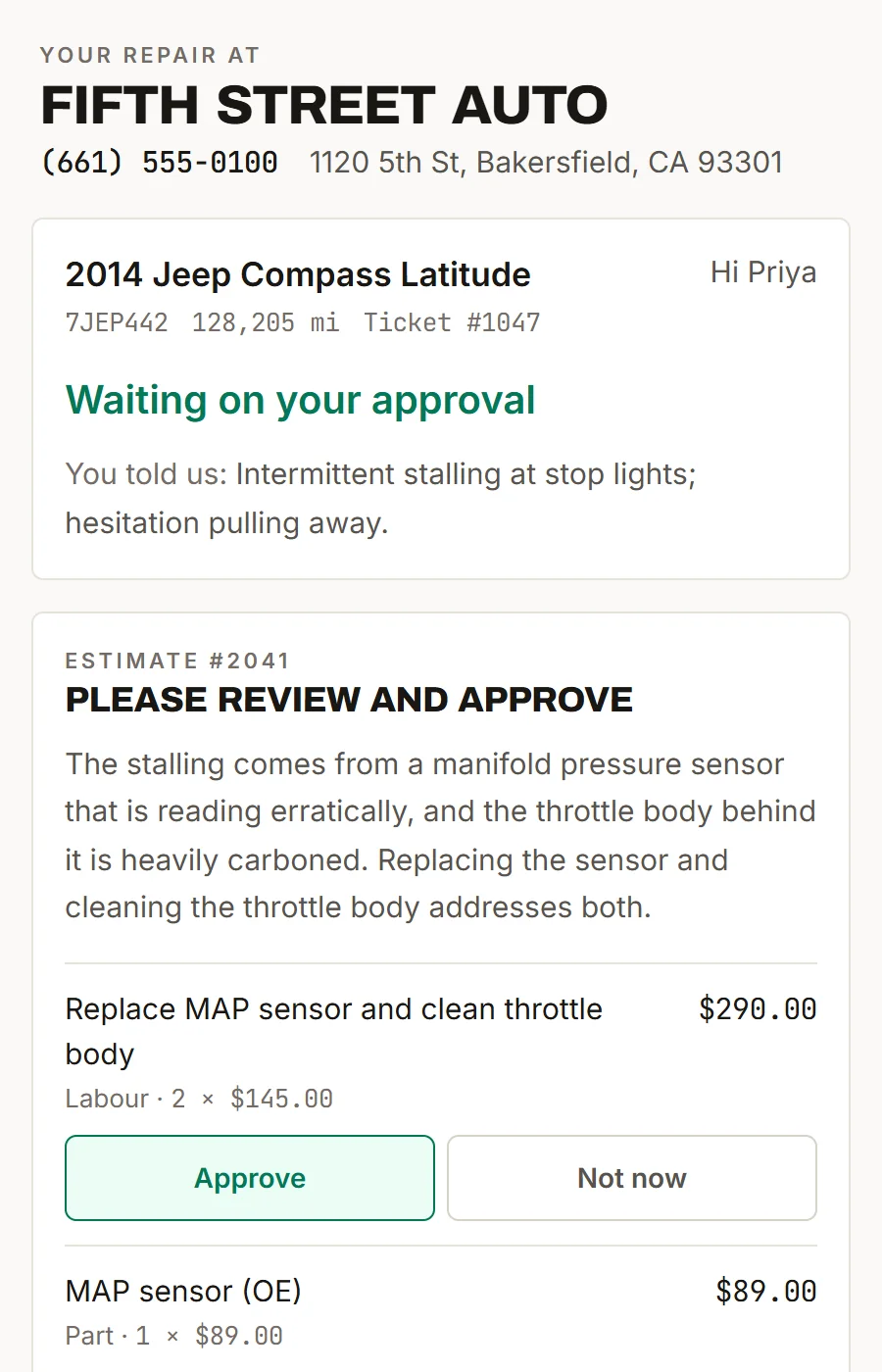
What the customer gets by text: their car, the inspection, the estimate to approve line by line, the invoice to pay. No app, no sign-in.
What’s in it
One system, the whole shop
- Today
- The day at a glance: appointments, what's in the shop, what needs a person, revenue, technician load.
- Calls
- Every conversation ZOL has had — transcript, what it extracted, what it booked.
- Schedule
- A day per bay, with technicians. Arrive, check in, and the ticket opens itself.
- Repair orders
- The board, and the workbench: diagnostics, digital inspection, lines and approvals, estimate, parts, invoice, conversation, history.
- Inspections · Estimates · Parts · Invoices · Payments
- Shop-wide views of the same records.
- Technicians
- Each tech's queue, with one-tap status moves.
- Customers · Vehicles
- The connected record: visits, messages, calls, declined work, lifetime value.
- Messages
- Every thread with a customer, texts and portal messages alike.
- Follow-ups
- The CRM: declined work, inspection recommendations, post-repair check-ins, birthdays, win-backs — drafted by ZOL, sent by a person.
- Ask ZOL
- Questions about the shop, answered from its own data, with links to the record.
- Team · Settings
- People, pricing, hours, the quote cap, and which integrations are live.
- Customer portal
- The customer never signs in. Every estimate and invoice text carries a link to their car, its status, the inspection, the estimate to approve line by line, and the invoice to pay.
Two minutes, nothing to install. Nothing changes on your phone line until you say so.
Fig. 04·Screens captured from the ZOL app on the demo shop — the product, not a rendering of it.
06·Founders
Who’s behind
ZOL
Two technical founders, building in San Francisco, who spent two months embedded in independent mechanic shops. We didn't come to this market — we came from it.

Co-founder · CTO
Amol S Bhalerao
- Master's in AI / Machine Learning
- VLM researcher
- ex-Infosys · ex-Tata Motors
- 3× Startup Challenge winner
- 10+ years shipping at scale
Fig. 05·The founders — real names and photographs. The links go to public profiles off this site.
Questions
The things shop
owners ask first
Straight answers. If yours isn't here, ask it on the demo.
What happens to the shop software I run now?
ZOL takes its place. Tekmetric, Shopmonkey, Shop-Ware, Mitchell 1 and AutoLeap are good at recording the work — that's what they were built for — but somebody on your team still has to answer the phone, chase the approval and call about the part. ZOL keeps the same record and does that work too, so you're paying for one system instead of shop software plus an answering service plus a texting add-on. Customers, vehicles and repair-order history come across during onboarding, and everything stays exportable.
Will my customers know they're not talking to a person?
It introduces itself as Zol and it won't claim to be a human if someone asks. In practice callers care about two things: that somebody picked up, and that whoever picked up knew their truck. It does both.
What happens when it doesn't know the answer?
It says so. It won't invent a diagnosis or a price it isn't sure about — it takes a number, flags the call for you, and you can set it to transfer straight to your cell for anything outside what you've told it to handle. Everything it did is on the board with the full conversation attached.
Does this replace my service advisor?
No. It covers the hours nobody is standing at the counter, and the calls that come in while your advisor is already on the other line. Shops with an advisor use it for after-hours and overflow; shops without one use it as the counter.
Where do the quoted prices come from?
From you. Your labor rate, your book times, your parts margin, set during onboarding. Nothing goes to a customer at a number you haven't approved, and you can cap what it's allowed to quote without checking with you first.
Does it text customers from a robot number?
No. It works on your shop's own line, so the number your customers already have keeps working. When a person on your team picks up a thread, ZOL steps aside.
Who owns the recordings and the customer data?
Your shop does. It lives in your shop's own database, you can export all of it whenever you want, and you can have it deleted. We don't sell it and we don't hand your customer list to another shop.
It rings again tonight
See it answer
your phone
Twenty minutes. We'll put a call through ZOL while you listen, price a job at your rates, and show you the repair order it writes — on your own shop's numbers.
Opens our calendar · no card, no commitment